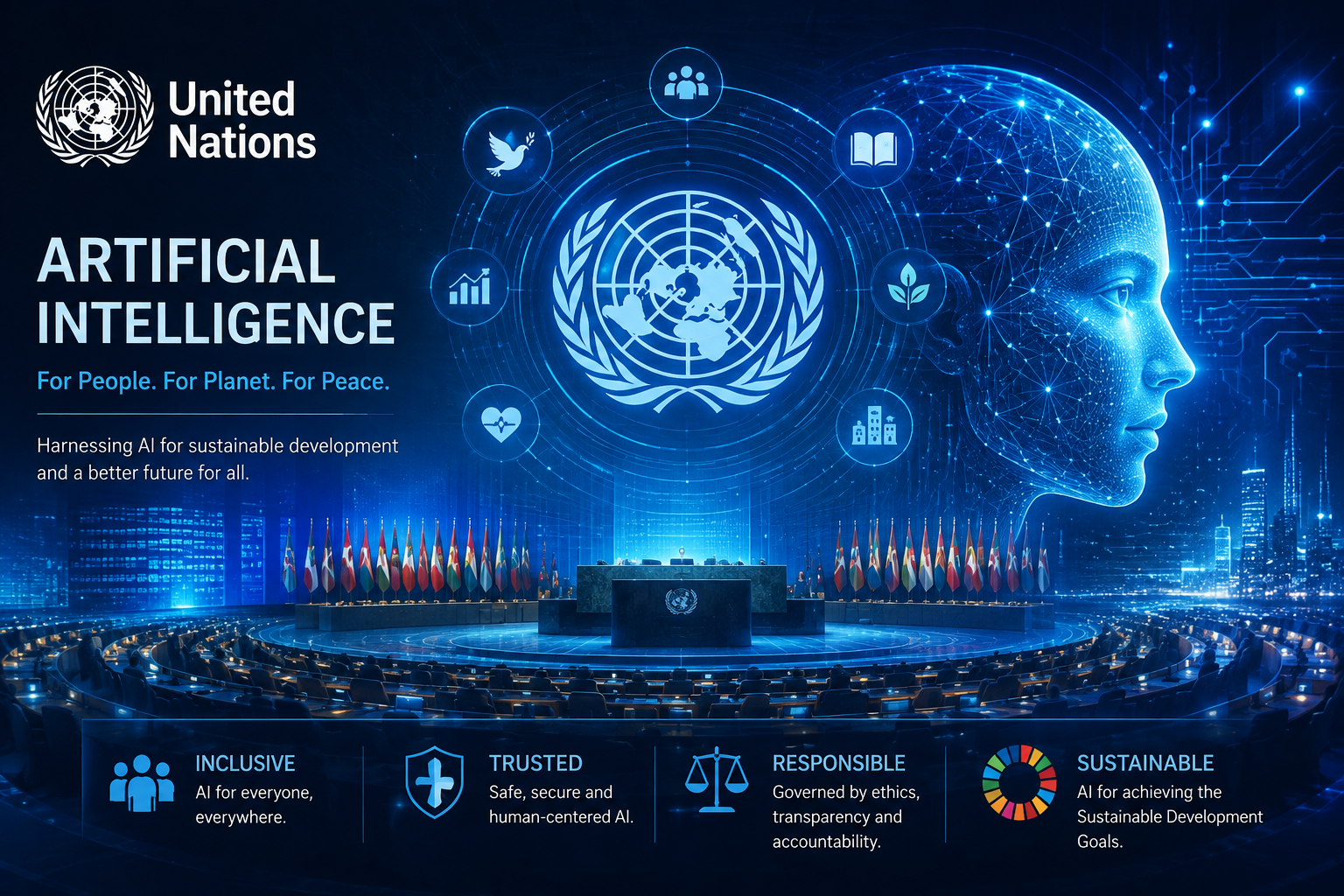
Global Dialogue on AI Governance
Artificial intelligence (AI) is reshaping economies, societies, and daily life. Its opportunities are real. So are its risks.
The UN reports that more than eight in 10 young people aged 15 to 24 worldwide are now online, and in low-income countries they outpace the rest of the population nearly two to one. This deeply connected generation too often bears the brunt of the risks to information integrity, including disinformation, harassment, algorithmic biases and the malicious use of artificial intelligence (AI).
No single country can address either the risks or the opportunities offered by AI. The Global Dialogue on AI Governance (AI Dialogue) exists to ensure that governance reflects the priorities of all nations, not just the most technologically advanced, and that the benefits of AI are shared by all.
Established by the UN General Assembly, the AI Dialogue is the United Nations platform where all governments and stakeholders will convene to discuss international cooperation, share best practices and lessons learned, and facilitate open, transparent and inclusive discussions on artificial intelligence governance. For the first time, every country has a seat at the table of AI – to have the meaningful conversation the world needs.
The next AI Dialogue will run in New York from 3–4 May 2027, back-to-back with the 11th Multi-stakeholder Forum on Science, Technology and Innovation for the Sustainable Development Goals.
The 2026 Dialogue addressed the following thematic clusters:
AI opportunities and implications: social, economic, ethical, cultural, linguistic and technical dimensions – 4(c) the social, economic, ethical, cultural, linguistic and technical implications of AI.
Bridging AI divides: capacity-building, access and digital foundations – 4(b) capacity gaps, with a view to leveraging existing United Nations and multi-stakeholder mechanisms to support AI capacity-building to bridge AI divides, facilitate access to AI applications and build capacity in high-performance computing and related skills in developing countries; 4(g) the development of open-source software, open data and open artificial intelligence models.
Safe, secure and trustworthy AI: interoperability and compatibility of approaches – 4(a) the development of safe, secure and trustworthy AI systems; 4(d) the interoperability and compatibility of artificial intelligence governance approaches.
Respecting, protecting and promoting human rights: transparency, accountability and human oversight – 4(e) respect for and protection and promotion of human rights in the field of AI; 4(f) the transparency, accountability and robust human oversight of artificial intelligence systems in a manner that complies with international law.
More information
Global Dialogue on AI Governance: https://www.un.org/global-dialogue-ai-governance/en
UN calls for urgent action to protect children from online information risks: https://news.un.org/en/story/2026/08/1168103
New United Nations report reveals need for stronger international oversight of Artificial Intelligence: https://www.ei-ie.org/en/item/32771:new-united-nations-report-reveals-need-for-stronger-international-oversight-of-artificial-intelligence
Artificial Intelligence (AI): https://www.un.org/en/global-issues/artificial-intelligence