
COP31 Fails – Will Civilization Go the Same Way?
The COP31 talks ended on 22 November 2026 without consensus on an overarching outcome because it failed to mention fossil fuels which are by far the largest contributor to global climate change, accounting for around 68 per cent of global greenhouse gas emissions and nearly 90 per cent of all carbon dioxide emissions [1].
The UK Government responded in a way similar to many other EU countries: “The United Kingdom does not believe the cover decision proposed by the Presidencies meets the moment. We believe it moves us backwards on the science when we must accelerate implementation. It has compromised where it should have presented bold collective ambition on climate action. It is our responsibility to protect and uphold the Paris Agreement. It is our duty to protect communities across the UK, the Commonwealth and those most vulnerable to climate shocks.” [2]
And the effects of fossil fuels were made very clear, three days later, when it was reported that the world has had “six consecutive days 2C above preindustrial levels for first time… driven by long-term global heating caused by humans burning fossil fuels, and by an unusually large El Niño, which is approaching its peak.”[3].
But this is just the beginning of the problem. Historical records show that in the past the world has much hotter than it is today, as shown by the following graphic [4].
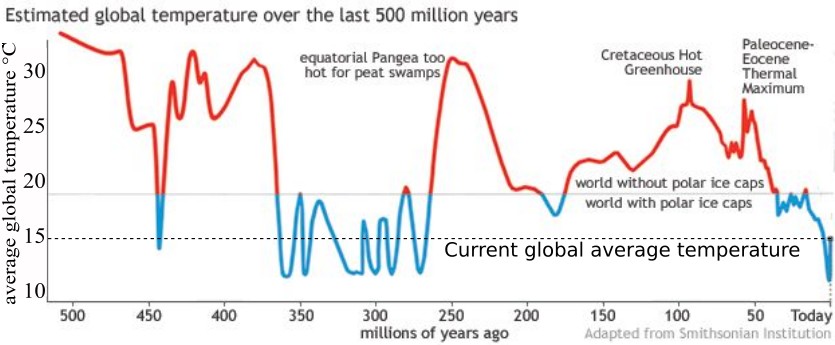
Based on Smithsonian Institution National Museum of Natural History
If fossil fuel burning continues at its present rate, global warming will increase even faster and we can expect all the ice at the polar ice caps to melt, significantly raising sea levels. But the effects on civilizations will be far greater than that.
Such topics have been very little investigated, but an article entitled “Climate Endgame: Exploring catastrophic climate change scenarios” published in the journal Proceedings of the National Academy of Sciences in 2022 [5], begins “Prudent risk management requires consideration of bad-to-worst-case scenarios. Yet, for climate change, such potential futures are poorly understood. Could anthropogenic climate change result in worldwide societal collapse or even eventual human extinction? At present, this is a dangerously underexplored topic. Yet there are ample reasons to suspect that climate change could result in a global catastrophe. Analyzing the mechanisms for these extreme consequences could help galvanize action, improve resilience, and inform policy, including emergency responses.”
And because the above graph shows that extremely high global temperatures have been fairly common in the past, there is every reason to expect they might return. If mankind continues to think only of today’s need for fossil fuels and fails to think about the consequences for future generations then climate change may well become an existential threat to human society and even to humanity itself.
References
[1] https://www.un.org/en/climatechange/science/causes-effects-climate-change
[2] https://www.gov.uk/government/news/uk-government-position-on-cop31-outcome
[4] Diagram based on https://www.science.org/content/article/500-million-year-survey-earths-climate-reveals-dire-warning-humanity