
Tom Fletcher remarks on US humanitarian funding
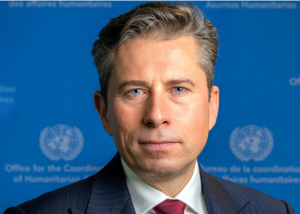 On 14 May Tom Fletcher, the Under-Secretary-General for Humanitarian Affairs and Emergency Relief Coordinator (OCHA), made the following remarks to the press in New York on US humanitarian funding.
Thank you very much, Ambassador Mike Waltz [U.S. Representative to the United Nations] and thank you, Under Secretary Jeremy Lewin [U.S. Under Secretary for Foreign Assistance, Humanitarian Affairs, and Religious Freedom] for being here today. And thank you for not just being here in presence, but as such, a key supporter for this life-saving work that lies ahead of us.
Those of you who are very attentive will remember I was here on 8th December and set out a plan for 2026 to reach 87 million people with life-saving support at the cost of $23 billion, which, as I said at the time, was less than 1 per cent of what the world would spend on guns, arms and security. It is less than half of what Wall Street spent on bonuses a few weeks ago. It is a fraction of what we spend on fizzy drinks or bottled water in places where we have access to fresh water itself.
An ambitious plan, but one that we had fully prioritized and costed, and which we are determined, as a humanitarian community, to deliver. And I said at the time that we were balancing three key aspects of this work.
Firstly, to retain our principles and our values around impartial, neutral, life-saving work.
Secondly, to reform the humanitarian system as we go along for the new realities that we face.
And thirdly, to get out there and raise the money that we need in a period when there is less money around for humanitarian action.
As you have heard me say many times, we are facing rising needs, over 300 million people need our support. And we are facing declining global funding.
We are, as a result, overstretched, under resourced and literally under attack.
I spent much of last night in touch with my colleagues in Ukraine as they responded to a double hit on OCHA convoys near the front lines. Completely unacceptable. We call for full accountability, full investigations, and we expect Member States to protect our work wherever we are.
So, as I said, we have a plan. And on 28th December, Under Secretary Lewin and I came together in Washington to announce a tranche of generous U.S. funding of $2 billion to that plan. And you will hear me say something now what you’ve never heard me say before, and I will probably never say again, I promise. But I have some slides [PowerPoint presentation attached].
So, the plan, against the odds, is working.
We are fundraising for that $23 billion and up to this point, in advance of the announcement you’ve just heard, we have raised $7.38 billion from 65 Member States, plus other public and private sources of funding. We are grateful for all of that support, but the most important number that I have for you today on the delivery of that plan is that we have already reached, in the first four months of the year, 14.4 million people with life-saving support – 14.4 million people. That’s a headline that we should all be proud of and that we should celebrate.
How did we do this with the first tranche of U.S. funding? So, that contribution provided us a lifeline at a crucial moment when the sector was facing huge cuts and was at breaking point with supply chains fracturing and partners operations at severe risk across all of the crises contexts in which we work. The risk was that millions of people would have been left without support.
So, it injected resources at a vital moment. You will see a slide now showing that the $2 billion U.S. tranche of money was for 18 crises across multiple regions, and that their contribution tripled the funding available through our pooled funds across those 18 countries. Six of those countries actually starting from zero in the pooled funds and four of them increasing almost tenfold. So, on the second slide, you will see then how we are delivering that work.
Now there were plenty of legitimate questions about how we were doing this. Could we allocate those funds quickly enough? Could the humanitarian system deliver at that scale? Could we live up to the standard of accountability we set ourselves and which are rightly demanded of us by our donors and by their taxpayers?
And I hope that the data we share with you today, and it is all available for you online, will show that we resoundingly, collectively as humanitarians answered yes to all of those questions.
As of today, we have $1.71 billion of that funding under implementation across those 18 countries and with it we are aiming to reach 22 million people with the U.S. allocation alone.
And of course, behind those numbers, as you have heard me describe many, many times, are individuals, names and families and communities living through the most horrendous crises.
So, to break that down a little bit more, over six million people will have received food assistance with that support. 10.4 million people will be provided with safe and sufficient water. We will be supporting over 690 health facilities, more than 779,000 households will get direct assistance, one of the fastest, most efficient, most dignified ways to support civilians in crisis. 300,000 girls and 266,000 boys will receive critical support for severe malnutrition.
And critically, a big chunk of that money will go to women and girls who are so often on the front lines of these crises. They will have access to safe spaces. Those who have survived horrific sexual violence will get support, and of course, women and girls always bear the brunt of that sexual violence.
On the next slide, I hope you will see that we are also working with this allocation and with the generous support of other donors to reform the humanitarian system.
To go back to the four “Ds”, and I won’t test you on the four Ds right now, but I know you all know them very well. We are defending our values and principles, international humanitarian law, wherever we work. The neutrality, the impartiality of our work, our protection of women and girls, and that priority of life-saving work in severity four and five, the most urgent cases.
We are defining that work more clearly around life-saving work, and you will all have read carefully the Global Humanitarian Overview that we released back in December that describes how we are doing that.
We are delivering much more efficiently and effectively against those goals, reducing duplication, bureaucracy and layers between the taxpayer and the recipient to make sure we do maximize the cents on every dollar that reach those who so badly need it.
And as part of those reforms, we are also devolving power to the country teams, the people closest to the communities we serve, to tell us how best to spend that money effectively, to save the maximum number of lives. That is also therefore empowering our local country teams and our extraordinary Humanitarian Coordinators in the field who are leading such important work.
Final slide, you will also see that we are doing this with complete transparency, and this is an innovation in the sector. For those who are really interested, you can dig into these figures. You can see exactly where we are spending the money, which partner organizations are delivering and who is having the right results as we seek to reach that target of 87 million lives.
We have established an online portal where you can explore all the aspects of that work.
Of course, as we go along, and this is important to our dialog and we met last week to review progress in the first quarter of the year, we are learning lessons as we go. We had an exercise to assess where we can improve the delivery of what we are doing.
And of course, we have consulted our amazing friends and partners across the humanitarian community, the UN agencies that are so vital to this work, and our partner NGOs. And I hope that as we learn those lessons, we will ensure we do more to prioritize women and girls, particularly around the victims of sexual violence; that we will get more community voices into the debate about what needs they face; that we will further enhance the risk oversight, the accountability and impact tracking mechanisms that are such a key innovation of this work; that we will continue our essential work with Member States, including prominently the U.S. to end conflicts, to deliver ceasefires, to work on the access agreements that we need to reach people in greatest need.
I would be happy to elaborate, in the Q&A, on several areas where over the last three or four days, we have made progress on those access agreements, including through the work we do with the U.S.
I hope, of course, that partners will also continue direct funding to the key front line agencies involved in life saving work.
We will be expanding the country list in response to feedback to make sure that we reach three more countries in urgent need of help.
And of course, just for clarity, we also hope that Member States and supporters will continue to support early recovery, resilience and long-term development. I have just returned from Syria with my friend and colleague [Administrator of United Nations Development Programme] Alexander De Croo.
We were talking about that transition to government-led and national-led recovery, so that the humanitarians can go home and move on to the next emergency. So, we welcome this new allocation. You will see there is a statement out from the Secretary-General, which, of course, I echo.
With this fresh funding we will save millions of lives.
It makes the U.S. our single largest national donor and this allocation will allow us to accelerate, expand on the progress made, saving lives, reforming the system, defending the impartiality and neutrality of humanitarian action.
Our focus going forward, now and for the rest of the year, is to secure the rest of the funding we need to deliver this ambitious plan, and then to get out there and deliver it, and to come back to you at the end of the year and ask you to hold us to account for what we have done and the choices we have made.
I can speak for humanitarians throughout the system in saying that while the challenges are growing, we will not shy from those challenges, and I end by paying tribute to their courage, tenacity and kindness in the face of huge challenges.
Thank you very much.