
UNRWA Chief of Staff receives UNA-UK award
On UN Day, 23 October 2025, UNA-UK presented the Sir Brian Urquhart Award for Distinguished Service to the UN to Ben Majekodunmi, Chief of Staff at the United Nations Relief and Works Agency for Palestine Refugees in the Near East (UNRWA).
His speech is shown below. In his 31-year career at the UN, Majekodunmi has worked for the organisation’s human rights, development, humanitarian and peace agenda across five world regions and multiple UN agencies, departments and missions. He also previously served as Senior Political Affairs Officer in the Executive Office of the UN Secretary General, under Secretary-General Ban Ki-moon and Secretary-General Guterres. Since 2021, he has been Chief of Staff at UNRWA, demonstrating remarkable resilience, integrity and courage at a time of unprecedented attacks on humanitarian workers and the organisation itself; more than 330 UNRWA staff have been killed in the last two years.
The event was held in partnership with the Embassy of Slovenia.
Presenting the Sir Brian Urquhart Award to Ben Majekodunmi, UNA-UK Chair Ian Martin, said: “It’s because of Ben’s commitments and personality that he has been and continues to be so effective a champion of human rights, and so thoroughly deserves this award.”
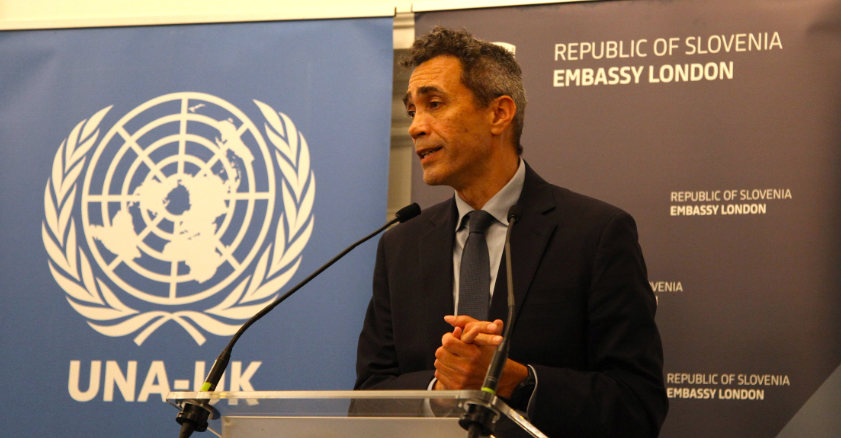
Ben Majekodunmi Speech UN Day 2025
What an introduction! Very encouraging to hear the rounds of applause for UNRWA, long before my name was mentioned, so I stand on UNRWA’s shoulders here.
First of all, let me give a very warm thank you again to the government of Slovenia and to the Ambassador: for hosting this event; but also for the enormous support, as Ian [Martin] has said, for UNRWA over the last two years. Those have been an incredibly rough two years on many, many fronts, including, in particular, on the political front. Political support for this UN organization and at this time has translated into saved lives.
Let me express my immensely warm thanks to UNA-UK for this award. I’m so humbled by it; I can’t really say just how much. Some of you knew Sir Brian personally, and you’ve shared with me just how special a person he was. So, to have my name associated with his, is a great honour. You’ve told me about his kindness, his commitment, his courage—moral, political, strategic, physical—and about his commitment to the idea of the UN. He famously joined the UN as the second-ever staff when the UN was but a piece of paper and an idea, post-Second World War, at that point.
I wanted to use this notion of ‘the idea of the UN’ as the basis for my remarks today. I’ll make two points, the second on UNRWA.
The first, in more general terms: what does the idea of an international civil servant mean? It has been famously written about by people including Dag Hammarskjöld, and every SecretaryGeneral since. To answer this question I draw, for myself, initially from the charter. The charter gives a little bit of guidance, but it doesn’t take you very far when you’re confronted by people who are coping with immense suffering – the charter does not really instruct you on what your duty is.
One of the first questions that I encountered in my UN career was in Rwanda. Arriving (at an unnamed young age), people were asking, “Well, where were you? Where were you when this started?” And not just when it started: “Where were you the year before, and the year before that, when people of one ethnic group were excluded from education, excluded from government, excluded from the right to freedom of movement, the right to express themselves; and were diminished in every public statement. Where were you?” And that sense of failure somehow, of inadequacy, has certainly stayed with me ever since.
To find, for myself, what the international civil service means, I frequently look at my colleagues. The UN has made mistakes, and does make mistakes—it is imperfect, of course, it cannot be otherwise. But the staffing body is quite outstanding. I can pick out the bureaucratic acronyms of UNICEF, UNDP, UNFPA, OHCHR and many, many others. Behind those acronyms, you have outstanding staff doing outstanding things, often unsung, often invisible.
Vaccinating children in far off places and getting those children into schools; getting their parents into work; getting their agriculture produce to a market, and making sure the money goes back to them; and so forth. Incredible colleagues who show incredible principle.
I’m inspired also by people. Perhaps the single most inspirational aspect of working for the UN is seeing how people who need the UN act. There are people who make potentially life or death decisions: “Do I go left with my children, or do I go right, in the midst of this war?”. And they make those decisions in part because of confidence in this organization, and in part because of confidence in the individual UN staff member standing next to them; because of a sense that the UN will provide a better option for them.
From the international civil service point of view, I think these actions, of staff and of people, are incredibly powerful.
For myself and my own reference points, I tell myself that I never have only one mandate:
there’s the mandate that you’re tasked to do; and then there’s the broader mandate of the UN charter. Your UN work is never just about delivering food to somebody; it’s also about how can that person live; how can they survive; how can they get the other things they need. Your UN mandate is always about a wider issue. It’s never about one population, it’s about everybody— which is a particular reason why I have loved working for UNRWA because, although the Agency’s immediate responsibility is directed toward Palestinians, in fact its operations benefit the entire region, including Israel, Jordan and other states.
So, the UN Civil Service and the idea of the UN, I think remains extraordinarily powerful today. We see it in people’s actions and the actions of UN staff, and in the courage of people and of staff. We see it also to a great extent in the actions of governments at the General Assembly. They vote in massive majorities for the excellent policies adopted by successive SecretaryGenerals, including the current one, on everything from peace and security to all aspects of development, to the place of women, of youth, of digital cooperation, of climate change, poverty, water, health, education—it’s all there.
There is hesitation in my voice because, as we know, around the world, governments are confronting a fear and worry amongst people: that they will be left behind; that they’re losing progress; that their children will not have the same lives that they do. This is leading to a fracture in government decision-making which finds its way to UN action, and dilutes support for UN and common action.
So, the idea of the UN is immensely powerful. It lives today: it’s spirit is alive in people, in UN staff, in government decisions, speeches and positions at the UN General Assembly. And yet it is challenged, and the idea, and peoples, requires our action and our protection all the more for it.
Secondly, UNRWA.
UNRWA is mandated to provide public services—education, healthcare, social security—to
Palestine refugees, until there is a political solution, such as a state, that is just and that protects their rights. Its value, including as recorded by the strategic assessment that Ian [Martin] led earlier this year, has been widely recognised. Value for the beneficiaries, value for the entire region, for its hosts Jordan, Lebanon and Syria, for the Palestinian Authority, and for the State of Israel, it is immensely valuable to all—Israel has been a long-time close partner of the agency.
It is an agency that, on the 7th of October—as the early morning news reached us of the horrors of what was happening in Israel, and then, the horrors of what has happened ever since—recognized quickly that the challenge ahead was an enormous one. You had the world’s single biggest UN agency – a huge asset to mitigate the unfolding situation in Gaza. It would be fundamentally our responsibility to do whatever could be done to mitigate the harm of the horror to come for 2.2 million people. And in doing so, we believed, I think very early on, that the Agency’s actions would be key to helping preserve whatever likelihood there was that Gaza could survive to be part of a future political solution.
Let me give you some examples.
Shelter: we quickly converted most of our 300 plus buildings in Gaza into temporary shelters. Converting a building into a shelter means getting water, power and solar panels there; finding staff – such as teachers – and assigning them to the shelter and asking “Can you please manage this shelter” and receiving their response “yes, I’m going to do it.” Within three to four months there were roughly one million people sheltering in or around the perimeter of UNRWA premises, with UNRWA staff ensuring that there was clean water, and food, and that living spaces are organized by family, that problems are dealt with, that women have a space that’s appropriate, that washing and toilet facilities are managed.
And then, healthcare: how do you provide healthcare, in the midst of a conflict, for 2.2 million people; and what happens if you fail when people are squashed together in terrible conditions? What would the death rate be if contagious disease breaks out? How do you provide healthcare when half of your health centres have been destroyed? As UNRWA, you provide it by moving your health centres and creating health points. We converted roughly 27 health centres into 45 movable health points. When people had to move with the conflict, those health points moved with them. Our staff on the ground have provided 10 million healthcare visits over the last two years. Where would Gaza be without those 10 million visits?
What do you do with children who are out of education for one month, two months, six months, one year or for two years? What happens if those children don’t go back to school? What are the prospects for a socio-economic revival, if one day there is a ceasefire, and what prospects for peace in the region, if those children—660,000 in total—never go back to school? What has UNRWA tried to do? We have tried to reopen schools where we could; and where we could not, we enrolled children in distance-learning using cell phones, pdf lessons and teachers teaching remotely however they could.
We have organized water and solid waste management for roughly 70% of the population, and food by supporting all other UN agencies.
In my last visit to Gaza, amongst the things that impressed me the most about what my colleagues were doing—and I stand on their shoulders—are things that are not really quantifiable. [I was] walking through an UNRWA school in Deir al Balah, roughly in the middle of Gaza, that was absolutely full of people, it was filthy and dirty, and there were children without shoes running everywhere. And yet it was a space that people felt was somehow safer than being outside, because there’s a UN flag and because there’s the UNRWA logo. And in that space, I remember very clearly meeting a young woman, very well and cleanly dressed, with a clipboard, and she said “I’m UNRWA staff. I’m co-managing this facility.” She was walking through the crowds, taking notes and saying, “What do you need? What do you need?” And from the people that we heard, this provided a sense of stability. Everything was falling around them – a sense that member states are not supporting them, the world is not supporting them, their families have gone, their homes have gone and their mosques or churches have been destroyed – but UNRWA was still there, somehow providing a modicum of stability.
Amidst this, of our personnel – 12,000 now left in Gaza – 377 have been killed, at least. We have difficulty knowing exactly, but far more than 500 children of our personnel have been killed. When talking with my Gaza-based colleagues, they will explain to me how UNRWA guards will still sit outside our headquarters in Gaza City— almost completely destroyed—and they’ll guard the building because of a sense of duty; or how staff who bury their children on a Monday will go to work the next day, because that’s their duty and because of their sense of responsibility.
So, as we talk of the ‘idea’ of the United Nations, we have that idea being lifted for us by these UN staff who have carried Gaza on their shoulders. I want to refer particularly also to Philippe Lazzarini, my boss, who has carried the world on his shoulders, I think, in particular. So, between Philippe and the Palestinian staff of Gaza, there’s an enormous debt I think, that we owe them, that Member States owe them, and I’m immensely honoured to work with them.
Let me conclude, then, by saying of the ‘idea of the UN’ that I feel so grateful to have had this journey with the UN so far – continuing hopefully for a while longer – because the idea remains incredibly strong.
I see it first and foremost in people and people’s reactions, in the confidence and the trust in the UN: the people who go to an UNRWA shelter even after it’s been destroyed once, they’ll go to it again because there is a sense that the UN emblem, the blue colour, is something that’s protective. You can’t create that. That is something that has been instilled in people. I think we’ve inherited this from Sir Brian. It is immensely powerful.
We see it also in the UN staff around the world. And we see it in the actions of governments at the General Assembly and at the Security Council.
There are fractures, there are fissures, of course. The idea needs to be curated.
Governments are, as many of you will know better than I, dealing with challenges, fears and concerns within their domestic populations that do not sit easily with the imperative of solutions to global problems. This, I think, is the biggest challenge that we face. And this is why I believe the work of UNA-UK, the UNA groups, the membership, the trustees, and the UN associations around the world is so important.
Jane [Kinninmont] said it very well: The idea of the UN is not an idea that belongs to UN staff, absolutely not. It belongs to people, it belongs to Member States. This is a collective idea. It’s incredibly powerful and incredibly important. It’s time has come, even more than at any moment since the Second World War.
We can thank Sir Brian for leaving us this tremendous legacy. Let us keep it going.
Thank you so much.