
Lazzarini quits UNRWA and warns of future risks
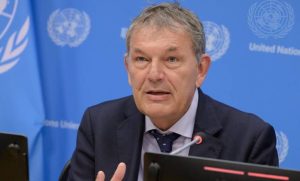
UN Photo/Manuel Elías
As Philippe Lazzarini steps down from his role as Commissioner-General of the United Nations Relief and Works Agency for Palestine Refugees in the Near East (UNRWA) on 31 March 2026, he warns that the whole system of International Law is in danger. The following are extracts from the article he wrote for the Guardian newspaper on 21 March.
I bow out of my role for the organisation at a perilous time for the international law. There are consequences not just for Palestinians, but the wider Middle East.
This month I will conclude my tenure as the commissioner-general of Unrwa – the United Nations agency that has provided essential, public-like services to Palestinian refugees across the Middle East for more than 75 years. As the world struggles to emerge from the quagmire of Gaza and the US-Israeli war against Iran threatens to engulf the entire region, I am profoundly concerned about the future of Palestinian refugees and the multilateral system at large.
Having endured more than two years of relentless physical, political and legal attacks, most fiercely in Palestine, Unrwa has reached breaking point. The risks to Palestinians’ rights and the stability of the region are immense.
In December 2023, amid the escalating brutality of the war in Gaza, I wrote to the president of the UN general assembly that in my 35 years of working in complex emergencies, I had never had cause to report the killing of 130 personnel, nor to predict the killing of many more. I did not imagine then that the number of colleagues killed would triple – the death toll is now more than 390 – or that so many others would sustain life-changing injuries, or be arbitrarily detained and tortured.
Hundreds of Unrwa premises in Gaza have been damaged or destroyed. The parliament of Israel adopted legislation to end the agency’s presence in occupied East Jerusalem, including by forcibly shutting schools and health clinics, and cutting off the supply of water and electricity to our premises. The Unrwa headquarters in East Jerusalem was seized, looted and set on fire, with senior Israeli officials celebrating the destruction on site and online. A deputy mayor of Jerusalem even threatened to “annihilate and kill all members of Unrwa”.
It is incomprehensible that a UN entity has been allowed to be crushed as Unrwa has, in violation of international law, with total impunity, and with staff and Palestinian communities paying an unacceptable price.
…
Beyond Gaza, Unrwa is a vital resource for protecting the rights of Palestinian refugees across the region and addressing the longstanding question of Palestine. However, without immediate and robust political and financial support, the agency will soon reach the end of its viability. A disorderly collapse of Unrwa would fuel insecurity, placing the full responsibility for delivering services to Palestinian refugees in the Palestine on Israel, as the occupying power, and foisting an enormous burden on Lebanon, Syria and Jordan as host countries. The suffering of Palestinian refugees, who have endured generations of displacement and destitution, would be compounded.
It is appalling that despite Unrwa’s crucial role, the agency has not been adequately protected by the international community. Instead, it has been allowed to become a proxy battleground in the Israel-Palestine conflict, pronounced guilty until proven innocent. While those who ordered and carried out shameful actions against Unrwa bear the greatest blame, everyone who purports to support international law should consider their responsibility.
…
The abject failure to muster an effective multilateral and international law-based response in Gaza enabled a war outside international legal boundaries – one that is now spreading across and beyond the Middle East. This failure has normalised disdain for the rules-based international order.
Unrwa may soon cease to exist, with devastating consequences not only for millions of refugees but for regional peace and stability, and for the rights-based international framework that we have worked so hard to build. We must act – not belatedly, but now – to mobilise a broad coalition determined to uphold international law and to defend multilateralism.