
The United Nations Security Council and Veto Rule explained
This Article by UNA Coventry volunteer Danila Mikheev is written for non-expert readers. It aims to attract a younger population to the United Nations Association website and increase awareness about the United Nations.
The United Nations Security Council (UNSC) is one of the 6 principal organs of the United Nations, alongside the General Assembly, Economic and Social Council, etc. See here for more details.
During formal UNSC meetings, delegates are seated in alphabetical order of country names. The primary job of the UNSC is to ensure international peace and security around the world. Furthermore, members decide whether military action should happen at a specific location and whether they should interfere in any already on-going conflicts. Lastly, members also decide on any international sanctions. For example, sanctions placed on DPRK (North Korea) in 2006 for testing nuclear weapons which was seen as a threat to global security and involved all UN member states being prohibited from directly or indirectly supplying weapons and related materiel to DPRK.
UNSC has 15 members, 5 of which are permanent members (China, France, Russian Federation, the United Kingdom and the United States) and 10 non-permanent members elected for two-year terms by the United Nations General Assembly. Each member has one vote during the voting procedure.
The veto rule consists of any of the 5 permanent Security Council members being able to use the veto power to prevent any resolution being passed which they do not like. This rule essentially gives these 5 delegations more decision power than the non-permanent members. After World War II ended in 1945, the 5 main powers who won (China, France, Soviet Union, the United Kingdom, the United States) insisted on having a veto power in order to prevent another World War from happening. Russia inherited the veto power after the fall of the Soviet Union as a “continuator state”.
A clear example of the use of veto power was in 1999. The Security Council voted on a draft resolution to extend a preventive peacekeeping mission working in the Republic of Macedonia. The majority was in favour (13 in favour, 1 abstention) but China voted against. This meant that the resolution failed and therefore the peacekeeping mission was not extended.
Permanent members can strategically use the veto rule to gain advantage on the international arena. The Russian Federation (including when it was the Soviet Union) and the United States tend to use veto power more than other permanent members – 129 and 89 times respectively since the creation of the veto rule.
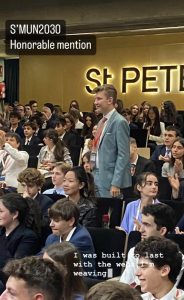 I personally believe that participating in Model United Nations (MUN) events is a great start for anybody who enjoys meeting people from different backgrounds and who is interested in politics, international relations or journalism. MUN is beginner friendly and allows students to learn about different countries that they might otherwise never study. I myself have participated in a number of Model UNs both as a delegate and as a chair and became the only recipient of an honorary mention in my college’s history.
List of countries where you can participate in Model UNs
- Afghanistan
- Australia
- Bahrain
- Bangladesh
- Brazil
- Canada
- China
- Colombia
- Cyprus
- Denmark
- Dominican Republic
- Egypt
- Finland
- France
- Germany
- Greece
- Hungary
- India
- Indonesia
- Israel
- Italy
- Japan
- Jordan
- Latvia
- Malaysia
- Morocco
- Namibia
- Netherlands
- Pakistan
- Peru
- Philippines
- Poland
- Portugal
- Qatar
- Romania
- Russia
- Serbia
- Singapore
- South Korea
- Spain
- Sweden
- Switzerland
- Taiwan
- Turkey
- United Arab Emirates
- United Kingdom
- United States
- Uruguay
- Venezuela
- Zimbabwe